Background
Industrial breweries are highly automated production operations with complex electrical infrastructures. The reliable operation of equipment such as pumps, compressors, and sensitive control systems depends significantly on a stable, high-quality voltage supply.
Despite advanced equipment, breweries often face a significant issue in this regard: network fluctuations caused by connected electrical loads. These disturbances not only affect the efficiency of the production processes but also shorten the lifespan of electrical equipment. This leads to higher maintenance efforts and thus rising costs.
The main cause of these problems are modern, power-electronically controlled devices such as LED lighting, frequency converters in ventilation systems, as well as pumps and conveyor systems. These consumers create strong non-linear loads in the network, which lead to a flat-topping of the voltages’ peak values. Such phenomena occur much more frequently today than a few years ago and pose an increasing challenge for industrial operations like breweries. A sustainable solution therefore requires targeted and efficient measures to improve the voltage quality and meet the increasing demands.
Challenges
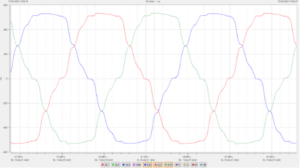
In advance, a clear distortion of the sinusoidal voltage waveform was detected during monitoring of the network. The high harmonic content already exceeds the permissible limits according to IEC 61000-2-4, EMC Class 2 at several points, which can lead to disturbances in the network.
Especially in highly automated processes, such as bottle filling systems in breweries, voltage supply disturbances can cause significant problems. Even with slightly flattened peak values, the intermediate circuits of frequency converters can no longer be properly recharged, causing entire converters to fail. Due to the high clock rate of the machine already small impairments can result in broken glass or even complete failure. Additionally, the increased load on the network can lead to higher costs for the brewery and equipment may lose its warranty.
Solution
To dampen the identified harmonics, a broadband filter was chosen, consisting of two SΦFIA® H5 modules and a SIMΩN® module. The SΦFIA® H5 module specifically manages the filtering of the strongly pronounced 5th harmonic.
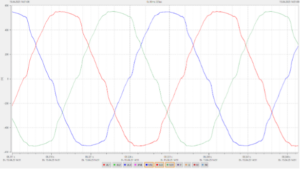
The additional SIMΩN® module provides broadband damping of the remaining harmonics which are then converted into a smoothed 50 Hz sinusoidal oscillation and fed back into the network.
This solution ensures:
- Full compliance with all relevant limits according to IEC 61000-2-4, EMC Class 2
- Targeted filtering of the 5th harmonic and broadband filtering by the SIMΩN® module
- Local energy recycling function
Measurement results
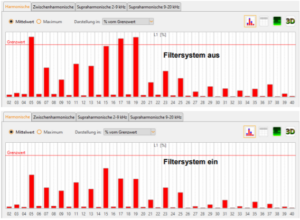
Voltage spectrum compared to the limit values according to IEC 61000-2-4, EMC Class 2
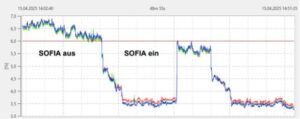
5th harmonic of the voltage
5th harmonic of the voltage in percent compared to the limit value (6%) of the standard IEC 61000-2-4 EMC Class 2.
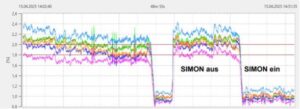
17th and 19th harmonics of the voltage
17th and 19th harmonic of the voltage in percent compared to the limit values (2% and 1.8%) of the standard IEC 61000-2-4 EMC Class 2.
Used products
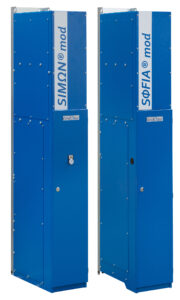
SIMΩN® mod
- Damping of harmonics up to 2.5 kHz
- Local energy recycling of harmonics
- Highly developed digital control
- Overload protection via automatic intelligent current limitation
SΦFIA® mod H5
- Filtering of the 5th harmonic
- Automatic adaption to grid changes
- Overload protection via automatic current limitation
- High power and reliability
- Easy installation and maintenance
- Low losses
Click here: Brewery Case Study as PDF
Background
Cruise ships operate while at sea as energy self-sufficient island grids, relying on onboard generators to supply electrical power. Due to limited generator power and high internal impedance, these systems exhibit – compared to an industrial grid supplied by the public network – low short-circuit power.
As a result, voltage distortions can occur across a wide frequency spectrum caused by connected loads. Even small capacitive elements, such as those found in EMC filters, can cause resonance phenomena at relatively low frequencies.
In addition, numerous nonlinear loads such as frequency converters, LED lighting, and battery chargers are in use. Their power electronics generate harmonics, which superimpose and distort the supply voltage. The combined effect of harmonics and resonant phenomena can lead to overload or even destruction of connected equipment. This may result in component overheating, erratic behaviour, or even total failure. Such events are especially critical in maritime environments, where reliability and safety are paramount. Electrical disturbances at sea can lead to costly damage, extended downtimes, and disruptions to onboard services and logistics.
Challenges
Before installing the modules, there were significant impairments in the voltage quality of the grid.
Particularly noticeable were overlapping high-frequency voltage distortions. These can place significant stress on network components.
In addition, a flattened voltage peak (so-called flat-topping) was observed: for a supply voltage of 690 V (phase-to-phase), the ideal peak value would be 975 V – however, only 943 V were measured. This deviation can cause problems when recharging the DC link of frequency converters.
Also critical were the clearly distorted zero crossings with double zero crossings of the voltage waveform, which can lead to malfunctions of protective systems.
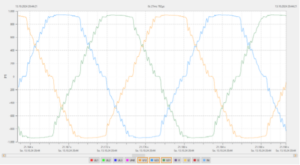
Power quality before installation of the modules: distorted zero crossings and high-frequency voltage distortions
Solution
By using the GridClass® modules, the voltage waveform can be effectively smoothed and the identified issues resolved.
With the integration of two SΦFIA® modules – voltage-controlled harmonic filters with intelligent adaptation – in the H5 version, the voltage peak is raised to 969 V. In addition, a cleaner waveform is achieved around the zero-crossing points.
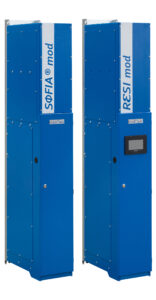
To specifically filter the seventh harmonic, the SΦFIA® module in the H7 version is used. All remaining higher-frequency distortions and resonances are reliably eliminated by one RƐSI module (Resonance Elimination System).
The specific combination achieves:
• Clean zero crossings
• An increased voltage peak level
• Elimination of high-frequency disturbances caused by harmonics and resonances
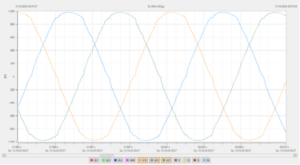
Power quality after installation of the modules
Measurement Results
THDᵥ before and after switching on the filter modules
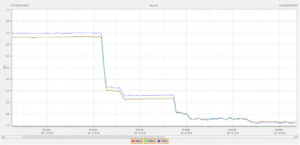
THDᵥ with filter system off and on
Voltage spectrum compared with IEC 61000-2-4 limits, EMC Class 2
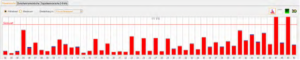
Voltage spectrum – filter system off
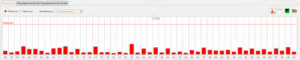
Voltage spectrum – filter system on
Used Products
SΦFIA®-Mod
• Filtering of harmonics
• Automatic adaptation to network changes
• Overload protection through automatic current limitation
• High performance and reliability
• Easy installation and maintenance
• Low losses
RƐSI-Mod
• Filtering higher-frequency interferences and resonances
• Passive adaptation to network changes
• High performance and reliability
• Easy installation and maintenance